

Make Yellowbacks Great Again

The publishing industry has gone in some directions I disagree with. Back in 2015 I focused my Writing Workshop essay on the differences between self-publishing and traditional publishing, grabbing examples of ‘good’ and ‘bad’ from both types.
Vanity publishing had its own appendix in the presentation, and true to the metaphor it was full of shit and fit to explode.
Maybe that was harsh. Not everything that’s vanity pubbed is shit, it’s just that most of it is. But so is most of everything, so I suppose it is a pointless statement.
I’ve known fantastic writers who have vanished for months, only to return with “Well, the publishing package was reduced to $4500” and I’ve wondered how someone smart enough to design an entire alien ecosystem is scammed like this, but you look at vanity presses and it is obvious.
They do not appeal to logic.
They appeal to emotion.
They operate like a horrible ex, playing your feelings and hopes. They entirely avoid, circumvent, and short-circuit the logic part of your brain. They just want money, and they will get it through any means.
They latch onto the natural desperation of writers, and leech you of your hard-earned money. It is not any writer’s fault if they fall for this. It’s a horrible practice, and it makes me yearn for a better world.
What if some parts of the past were better?
So. What is a yellowback book?
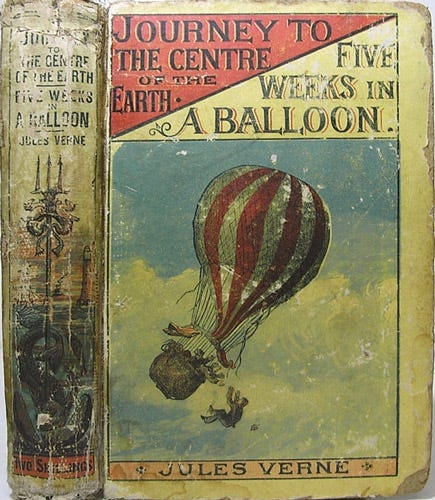
These were the 1800s equivalent of mass market paperbacks, and gained popularity for train journeys at a time where education was on the up. More people could read books, and so books made themselves more accessible and more affordable. They competed against the ‘Penny Dreadful’ type of books, and had a different readership entirely.
Perhaps when I wrote WHO BUILT THE HUMANS? as a modular collection novelthology of weird Sci-Fi and weirder Comedy, I had some Victorian sensibility in me. For my design philosophy was to have a book that worked on train journeys AND on quiet evenings. I think I did okay.
“Routledge was one of the first publishers to begin marketing yellow-backs by starting their "Railway Library" in 1848. The series included 1,277 titles, published over 50 years. These mainly consisted of stereotyped reprints of novels originally published as cloth editions. By the late 19th century, yellow-backs included sensational fiction, adventure stories, "educational" manuals, handbooks, and cheap biographies.”
I think we should bring back the yellowback. I have been working with some writers on this. We should have news soon…
My recent novella, THE COSMONAUT WHO DIED TWICE is perhaps my attempt at a Yellowback book. It has a yellow spine because I was playing with this idea of colour coding my books. The yellow spines are time travel stories. It’s a nice, short book, very popular at Geek Fayres, and slots nicely into the wider universe I’m working on, even though it is a standalone.
[ this post was originally written in 2022, and has been dug up and edited by myself now in 2025 (now 2026). This Substack is FREE, and is reader supported, which means book sales make up for a paid tier ]